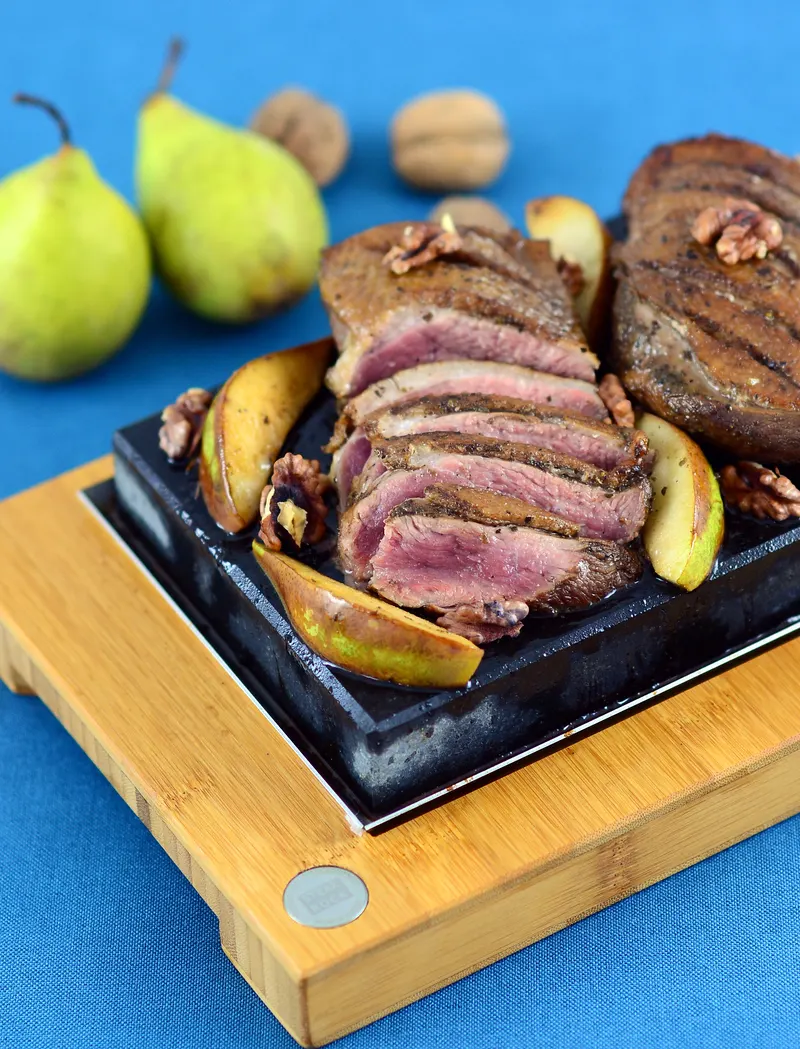
For restaurant owners, a new concept is not just about taste. It must also be practical, fit within the kitchen organisation and offer sufficient distinction compared to other hospitality businesses.
A Hotstone concept can be interesting in that regard. The core is simple: a lava stone is highly heated and retains that heat for a long time. The dish is then served on the hot stone, after which the guest determines for themselves how long meat, fish, or vegetables continue to cook.
That makes hot stone grilling not only a preparation method but also a part of the total restaurant experience.
Why lava stone?
An important advantage of lava stone is the ability to store heat well and release it over a long period.
For hospitality, this means that the stone is first heated in a suitable oven and then can be used at the table to finish cooking the dish.
With that, part of the experience shifts from the kitchen to the table.
The guest literally sees the dish cooking further and can decide for themselves when the desired result has been reached.
More control for the guest
In traditional steak preparation, the kitchen decides in advance whether a dish is served rare, medium, or well done.
Hot stone grill allows the guest to have more influence.
A piece of meat can, for example, be served on the hot stone and then be grilled further in smaller pieces. This allows every guest to determine for themselves how long a piece remains on the stone.
That makes the concept especially interesting for restaurants that offer steak, fish, seafood, or grilled vegetables.
A table concept that guests remember
The restaurant visit is increasingly about experience.
A dish that sizzles when it comes to the table, that spreads an aroma, and where the guest actively participates in the preparation, stands out.
That can be especially interesting for:
- brasseries
- steakhouses
- hotel restaurants
- leisure venues
- holiday parks
- restaurants looking for a distinctive evening concept
The product is not just eaten, but also experienced.
Pure preparation on stone
A Hotstone concept can fit well with a menu revolving around pure ingredients.
Meat, fish and vegetables can be prepared directly on the heated stone. As a result, it is not always necessary to use large amounts of extra fat during grilling.
That makes the concept suitable for simple dishes where the quality of the main ingredient is central.
Think, for example, of:
- beef
- chicken
- fish
- shrimp
- vegetables
- vegetarian products
The final nutritional value naturally depends on the complete dish, including sauces and side dishes.
Less complicated than it seems
For a restaurant, a Hotstone concept does not have to be operationally complicated.
The most important components are:
- keeping stones at temperature
- a fixed mise-en-place
- clear operation
- working safely with hot stones
- good circulation between oven, table and cleaning
Once this process is set up, a fairly predictable workflow emerges.
That is why professional Hotstone systems are often supplied as a complete restaurant setup instead of as a separate product.
Cleaning and daily use
A grill stone in hospitality must not only perform well during service, but also be practical for daily use.
The stones used have a smooth, polished structure. That makes the surface easier to clean than a highly porous or rough stone.
In addition, professional Hotstone sets are designed to safely place the hot stone in a holder and board.
That is important, because temperatures can rise high during professional use.
Safety is part of the concept
A Hotstone requires clear procedures.
That is why a professional implementation also includes attention to:
- safe stone handling
- correct temperature
- use of suitable grippers
- clear instructions for staff
- stable placement on the table
- explanation to the guest
A good concept is therefore not just beautifully presented, but also operationally well prepared.
Why restaurants often work with complete sets
In the hospitality industry, hotstone grilling is usually not added as a separate plate.
It is often introduced as a complete system.
That means that a restaurant looks at:
- number of seats
- expected number of Hot Stone dishes
- capacity during peak hours
- format of the tables
- space in the kitchen
- required oven capacity
- number of extra stones
- accessories for safe use
A small restaurant has different needs in this regard than a hotel restaurant or a venue with one hundred seats.
Starting small is also possible
A Hotstone concept does not have to be available on every table immediately.
A restaurant can, for example, start with a limited number of sets and put the concept on the menu as a special dish.
That gives room to test:
- how guests respond
- how many orders actually come in
- how the floor staff works with it
- how fast stones circulate
- which dishes sell best
When the concept catches on, the capacity can be expanded later.
That makes it also interesting for smaller hospitality businesses that do not want to make a large investment immediately.
The concept must fit the menu
Hotstone works best when it is not a standalone gimmick product.
It must become part of the restaurant formula.
A strong application can, for example, consist of:
Hotstone steak with three homemade sauces and a separate side dish.
Surf & turf on Hotstone with meat and seafood.
Fish on Hotstone with fresh herbs, lemon and vegetables.
Vegetarian Hotstone with seasonal vegetables and matching dips.
In that way, the same basic concept is used in multiple ways.
An extra sales moment at the table
For restaurant owners, the commercial side is also relevant.
A Hotstone dish lends itself to premium presentation.
That is why it can be combined with:
- premium meat selections
- extra sauces
- side dishes
- wine pairings
- desserts
- special menu combinations
The concept does not only have to generate revenue through the main course itself.
It can become part of a broader sales strategy.
Hotstone grilling as a distinctive hospitality concept
For restaurants looking for a combination of experience, simplicity and a striking presentation, Hotstone grilling can be interesting.
The power is not just in the stone.
It is in the combination of:
warmth, interaction, presentation, control for the guest and a clear restaurant concept.
Especially for entrepreneurs who want to distinguish themselves without rebuilding their entire kitchen concept, that can be an interesting direction.
Would you like to know if it fits your restaurant?
Chefs Stonegrill Alliance helps hospitality businesses assemble a suitable Hotstone setup for their business.
In doing so, we look not only at the number of sets, but at the full practical use: seating, table layout, service, kitchen, and desired capacity.
Would you like to know which Hotstone setup fits your restaurant? Feel free to contact us for advice without obligation.