
Introducing Stonegrill in your restaurant
Twelve topics to review before the first guest sits at the table. Each topic contains explanations and questions that you can answer together with your kitchen and service team.
Temporary: the checking off is not saved anywhere and disappears when you leave, refresh, or close this page. It is a preparation tool and not an approval or inspection of your business operations.
- 01
Does Stonegrill fit your restaurant?
Start with your guests and your formula, not the number of platters. Stonegrill can be a signature dish, an extra choice on the menu or a more extensive table concept.
- For which guests is it intended?
- Will it be a permanent dish, a special, or a package?
- Which presentation fits your restaurant?
- 02
Make your menu concrete
Define the ingredients, portions, sauces and side dishes before choosing a set. Besides steak, fish, seafood and vegetarian applications are also possible.
- Which dishes and portion sizes do you want to offer?
- Which sauces and garnishes do you serve with it?
- How do you arrange allergen information and suitable alternatives?
- 03
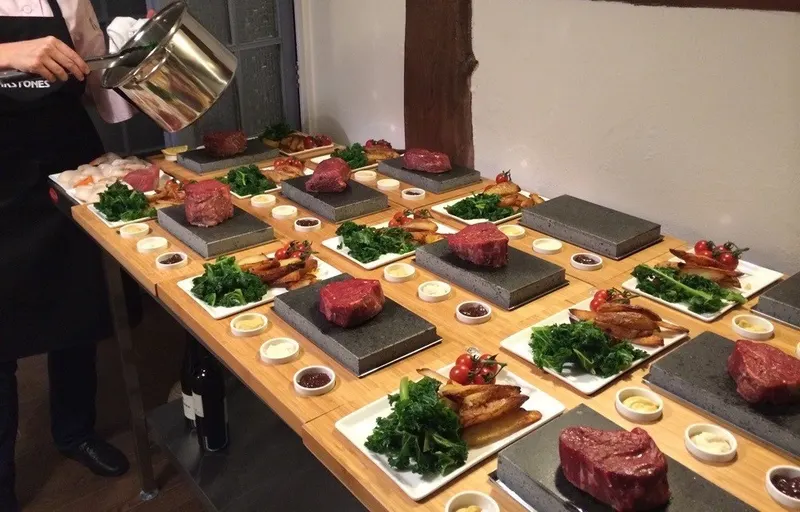
Test a fully laid table
An empty board on an empty table says little. Test with glasses, cutlery, sauces, and side dishes, even when multiple guests order Stonegrill at the same time.
- Does the chosen set fit on your own tables?
- Is there room left to eat comfortably?
- Can the service team place the dish stably?
- 04
Estimate the simultaneous demand
The busiest period of the service is more important than the total number of dishes sold per day. The number of seats is therefore not a direct order list for sets.
- How many guests are expected to order at the same time?
- When is your peak moment?
- What reserve do you want to work with?
- 05
Check space and technology
Align the oven and workspace with your kitchen. Power requirements, heating time, and capacity depend on the actual appliance chosen.
- Which electrical connection and capacity are available?
- Is there a suitable place for the oven and for serving?
- Have the technical requirements of your equipment been checked?
- 06
Plan sets, stones and oven as a whole
During service, stones are with guests, in cleaning, and in preparation simultaneously. Reserve and circulation stones must therefore match your peak demand and heating capacity.
- How many stones are in use at the same time?
- How many can you bring to temperature in time?
- Is there enough reserve for the next serving?
- 07
Give guests a short, fixed explanation
Every employee must be able to explain clearly what is hot, how the guest finishes the dish and which procedure belongs to the dish.
- Does the whole team know the standard explanation?
- Are hot parts clearly identified?
- Can the service team answer questions about cooking and use?
- 08
Arrange the handling of hot components
Before the first service, make agreements about suitable tools, safe drop-off points, stable placement, and clear circulation paths. Follow the instructions of the supplied system.
- Are the prescribed tools available?
- Where can hot components be placed safely?
- Has the team practised the procedure together?
- 09
Include Stonegrill in your hygiene plan
The existing food safety rules continue to apply. Keep raw ingredients and ready-to-eat components separate and organize the cleaning of contact surfaces.
- Where are raw products prepared?
- How do you prevent cross-contamination during preparation and service?
- How are return flows and clean material separated from each other?
- 10
Follow cleaning procedures per component
A stone, bamboo board, stainless steel holder, and porcelain do not automatically require the same treatment. Use the manufacturer's maintenance instructions for each part.
- Which parts need to cool down first?
- What can go in the dishwasher and what is cleaned by hand?
- Where can components dry before they are stored?
- 11
Make room for storage and preparation
Do not just think about table space: clean trays, stones, and porcelain need a dry, tidy, and easily accessible place behind the scenes.
- Is sufficient dry storage space available?
- Can the team set up complete sets efficiently?
- Are reserves stored logically and safely?
- 12
Run an internal test service
Test the whole process under realistic conditions. This way you discover before the introduction whether presentation, explanation, distribution, return, and cleaning align well.
- Does the setup work with multiple simultaneous orders?
- Are all parts available at the right time?
- Which agreements need to be adjusted after the trial service?
Walk through your situation together?
View our products or tell us where things are tough in your business. We will propose a suitable concept.
Based on a previous version of this guide: historical source